
- Mon-Fri 9am-5pm
- [email protected]
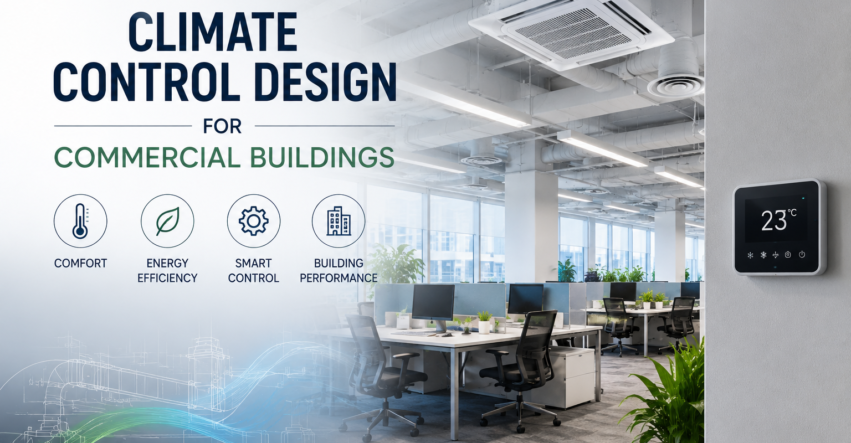
Modern commercial buildings are expected to do more than simply provide indoor comfort. Offices, retail spaces, hotels, restaurants, and mixed-use developments now require climate control systems that improve energy efficiency, support occupant wellbeing, reduce operational costs, and integrate seamlessly with architectural design. This is where professional climate control design becomes essential.
At InnoDez, we provide intelligent HVAC and MEP engineering solutions tailored for commercial environments. Our climate control design approach focuses on balancing comfort, efficiency, sustainability, and long-term building performance.
Climate control design refers to the planning and engineering of heating, ventilation, and air conditioning (HVAC) systems that regulate indoor temperature, humidity, airflow, and air quality within a building.
For commercial projects, climate control design involves much more than selecting HVAC equipment. It includes:
A properly designed system ensures that every area of the building maintains comfortable conditions while minimizing energy consumption and operational issues.
Commercial spaces experience varying occupancy levels, heat loads, operating hours, and ventilation requirements. Without proper HVAC engineering, buildings can suffer from:
Professional climate control design helps eliminate these issues early in the design phase.
Every building has unique heating and cooling demands based on:
Accurate HVAC load calculations help determine the correct equipment capacity, preventing systems from being oversized or undersized.
Proper airflow is critical in commercial environments. Engineers must design systems that distribute conditioned air evenly while maintaining fresh air circulation.
Effective ventilation design improves:
Ventilation systems must also comply with local building codes and energy regulations.
Energy costs are one of the largest operational expenses for commercial properties. Modern climate control design focuses heavily on reducing energy consumption through:
Energy-efficient systems can significantly reduce long-term operational costs while supporting sustainability goals.
Modern commercial projects increasingly rely on intelligent building management systems (BMS) that automate HVAC operations.
Smart climate control systems allow building owners to:
This integration creates more responsive and efficient building environments.
In commercial projects, HVAC systems must coordinate with structural, electrical, plumbing, and architectural elements within limited ceiling and utility spaces.
Using BIM and Revit MEP coordination helps:
At InnoDez, BIM coordination is a key part of our commercial climate control design process.
Different commercial buildings require different HVAC strategies.
Focus on employee comfort, ventilation, and energy savings.
Require specialized ventilation and kitchen exhaust systems.
Need individual room comfort control and quiet HVAC operation.
Require balanced airflow and temperature consistency for customer comfort.
Need flexible HVAC zoning to support different occupancy requirements.
Working with experienced MEP engineers provides several long-term advantages:
The future of climate control design is moving toward smarter, greener, and more adaptive systems. Trends shaping the industry include:
Commercial buildings that invest in modern HVAC engineering today are better prepared for future energy standards and occupant expectations.
At InnoDez, we provide commercial climate control and MEP engineering solutions for a wide range of projects, including:
Our team focuses on creating HVAC systems that combine performance, sustainability, coordination, and long-term operational efficiency.
Whether you are developing a new commercial property or upgrading an existing facility, professional climate control design plays a critical role in the success of the project.


