
- Mon-Fri 9am-5pm
- [email protected]
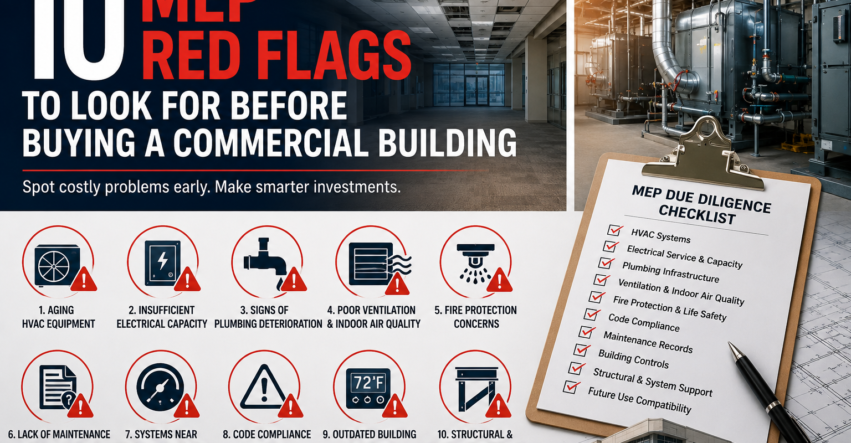
Buying a commercial building is a significant investment, and what you see during a property tour tells only part of the story.
Fresh paint, renovated interiors, and an attractive exterior can make a property look move-in ready. However, some of the most expensive problems may be hidden above ceilings, behind walls, inside mechanical rooms, or within the building’s electrical and plumbing infrastructure.
Mechanical, electrical, and plumbing (MEP) systems affect nearly every aspect of a commercial property, from occupant comfort and energy consumption to safety, code compliance, and future renovation costs.
Identifying potential MEP problems before purchasing a property can help buyers and developers better understand the building’s condition, estimate future investment requirements, and determine whether its existing infrastructure can support the intended use.
Here are 10 MEP red flags to look for before buying a commercial building.
Heating, ventilation, and air conditioning equipment represents a major building investment. Older equipment is not automatically a problem, but its age, condition, maintenance history, efficiency, and expected remaining service life should be carefully evaluated.
Potential warning signs include:
The important question is not simply whether the HVAC system works today.
A buyer should understand how much useful service life may remain and whether the system can support the property’s intended future use.
For example, converting an office building into a restaurant, fitness center, medical facility, or other higher-demand use can substantially change heating, cooling, ventilation, and exhaust requirements.
An HVAC system that adequately serves the current building may not have sufficient capacity for the proposed renovation.
Electrical capacity is becoming increasingly important as commercial buildings add more electrically powered equipment.
A property’s existing electrical infrastructure may have been designed decades ago for significantly lower loads than a modern renovation requires.
Potential red flags include:
The proposed use of the building should also be considered.
A renovation could add loads from:
If the existing service cannot support the anticipated demand, a service upgrade may be necessary.
Such an upgrade can involve more than installing a larger electrical panel. Depending on the project, utility coordination, transformers, switchgear, new feeders, or other infrastructure may be required.
Understanding electrical capacity early can prevent a major budget surprise after purchasing the property.
Many plumbing problems remain hidden until leaks, pressure problems, drainage issues, or equipment failures occur.
During an assessment, visible portions of the plumbing infrastructure can provide clues about the overall condition of the system.
Warning signs can include:
Older commercial buildings may contain piping that has been modified many times as tenants and building uses have changed.
A professional assessment can help determine whether existing plumbing infrastructure is suitable for continued use or whether significant repairs or replacement should be considered in the renovation budget.
A building can maintain a comfortable temperature while still having inadequate ventilation.
Ventilation introduces and distributes outdoor air and helps control indoor contaminants, odors, humidity, and overall indoor air quality.
Potential warning signs include:
Ventilation becomes particularly important when changing the use of a property.
Restaurants, fitness centers, laboratories, medical facilities, salons, commercial kitchens, and other specialized spaces may have ventilation or exhaust requirements very different from those of standard office or retail buildings.
The existing system should therefore be evaluated based on the future occupancy and use, not only current conditions.
Water stains should never automatically be dismissed as cosmetic issues.
Moisture can originate from roof leaks, plumbing failures, condensate systems, HVAC equipment, drainage problems, or other building systems.
Look for:
The source of moisture should be identified before purchasing the property.
For example, recurring ceiling damage could indicate a leaking pipe, improperly insulated ductwork, a condensate drainage problem, or an issue with rooftop equipment.
Treating the visible damage without addressing the underlying cause can result in repeated repairs and additional costs.
One of the biggest risks when purchasing a commercial property is assuming that because the building currently functions, its systems will support a new use.
Different occupancies can place dramatically different demands on MEP infrastructure.
Consider an office being converted into a restaurant.
The project may require:
A retail-to-fitness-center conversion may require increased ventilation, showers, locker rooms, additional hot water, humidity control, and greater plumbing capacity.
Similarly, converting a warehouse into a manufacturing facility may introduce substantial electrical, exhaust, ventilation, compressed air, or process loads.
Before purchasing a property for a specific development, determine whether the existing MEP systems are compatible with the proposed use.
Commercial buildings often change over time.
Tenants move in and out. Spaces are remodeled. Equipment is replaced. Walls are relocated. Electrical circuits are added. Plumbing is modified.
Unfortunately, documentation does not always keep up with these changes.
Red flags may include:
Poor documentation does not necessarily mean a building should be avoided, but it can make renovation planning more difficult.
Additional field investigation may be necessary before engineers can develop accurate designs.
Reliable documentation can significantly simplify the renovation of an existing commercial building.
Ideally, buyers should look for records such as:
However, drawings labeled “as-built” do not always represent current conditions.
Buildings may have undergone years of undocumented changes.
When documentation is unavailable or unreliable, engineers may need to conduct field surveys to identify equipment, trace accessible systems, document panel information, verify capacities, and establish existing conditions.
That additional investigation should be considered when planning the project schedule and budget.
One poorly maintained piece of equipment may be manageable. Evidence of neglected maintenance throughout the property can indicate a much larger problem.
Watch for patterns such as:
Deferred maintenance can shorten equipment life and reduce system performance.
More importantly, widespread neglect may indicate that the current owner has invested very little in the building’s infrastructure over time.
Buyers should consider not only immediate repairs but also the possibility of multiple systems requiring upgrades within the first few years of ownership.
A building may satisfy your immediate requirements but offer very little flexibility for future growth.
For developers and long-term owners, this can become an important limitation.
An MEP assessment should consider whether the property has room for future:
For example, an electrical service operating close to its available capacity could make future tenant improvements more difficult.
Similarly, mechanical rooms with no additional space or HVAC systems operating near their limits can restrict future modifications.
A building with some infrastructure flexibility may provide greater long-term value than one requiring major upgrades every time its use changes.
Finding one of these red flags does not necessarily mean you should walk away from a property.
Instead, it means you need more information.
Before making a final decision, consider asking:
These questions can help identify areas that require closer engineering review.
An MEP issue does not automatically make a commercial property a poor investment.
What matters is understanding the scope, cost, and impact of the problem before making a decision.
For example, an aging HVAC unit may simply need to be included in a future replacement budget.
Insufficient electrical capacity, however, could require a larger infrastructure project involving the building and utility provider.
Likewise, inadequate plumbing for a proposed restaurant could significantly affect the renovation layout and construction cost.
Once potential problems are identified, an MEP engineer can help evaluate possible solutions and determine how they may affect the planned project.
The best time to discover an infrastructure limitation is before purchasing the building or finalizing the renovation design.
Early MEP due diligence can help property buyers and developers:
It can also help distinguish between manageable maintenance issues and major infrastructure limitations that could materially affect the project.
A commercial property can look excellent during a walkthrough while hiding significant mechanical, electrical, and plumbing challenges.
HVAC equipment, electrical capacity, plumbing infrastructure, ventilation, fire protection, controls, and future expansion capability all contribute to the property’s true condition and long-term value.
Before purchasing or committing to a major renovation, understanding these systems can provide a much clearer picture of what you are actually buying.
A professional MEP assessment can help identify potential red flags early and provide the technical information needed to make better investment and project-planning decisions.
InnoDez provides MEP engineering and building assessment services for commercial properties and renovation projects.
Our engineers can evaluate existing mechanical, electrical, and plumbing systems, identify potential infrastructure limitations, and help determine whether existing systems can support your planned project.
Whether you are purchasing an office, retail property, industrial facility, or a building planned for conversion, early engineering evaluation can help reduce uncertainty and avoid costly surprises later.
Planning to purchase or renovate a commercial property? Contact InnoDez to discuss an MEP assessment before moving forward with your investment.


