
- Mon-Fri 9am-5pm
- [email protected]
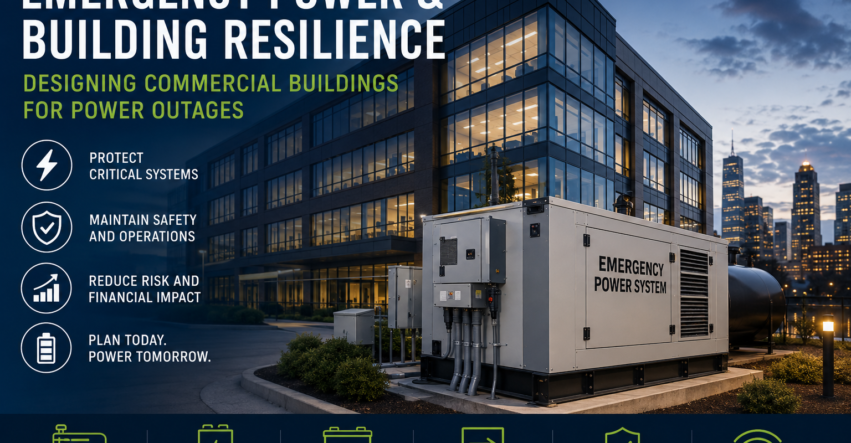
Modern commercial buildings depend on electricity for almost every critical operation.
HVAC systems, elevators, security equipment, fire and life-safety systems, communications, refrigeration, medical equipment, servers, lighting, and building controls can all be affected when utility power is interrupted.
For some facilities, even a short outage can create safety concerns, operational disruption, equipment damage, product loss, or significant financial costs.
This is why emergency power and electrical resilience should be considered early in the design of commercial buildings.
An emergency or backup power system provides electricity to selected building loads when the normal utility supply becomes unavailable.
Depending on the building and its operational requirements, backup power may be provided through systems such as:
The appropriate solution depends on which loads need to remain operational, how quickly power must become available, and how long the facility needs to operate without normal utility power.
Although the terms are sometimes used interchangeably in everyday conversation, emergency, legally required standby, and optional standby systems can have different functions and code requirements.
Emergency systems generally support loads necessary for life safety.
Other standby systems may support operations or equipment that building owners want to maintain during an outage.
Examples could include:
Determining which systems require backup power is therefore one of the first steps in resilient electrical design.
Not every electrical load needs to operate during an outage.
Trying to power the entire building can significantly increase generator size, equipment requirements, space requirements, fuel consumption, and project cost.
Instead, engineers work with owners and project stakeholders to identify critical loads.
Depending on the facility and applicable requirements, these may include:
Emergency lighting, fire alarm equipment and other required life-safety systems must remain operational according to applicable codes and project requirements.
Access control, surveillance and security infrastructure may need continuous power during utility outages.
Certain HVAC equipment, smoke-control systems, pumps or ventilation equipment may need backup power depending on the building.
Data centers, offices and technology-dependent facilities may require uninterrupted operation of servers, network equipment and communications systems.
Restaurants, supermarkets, cold-storage facilities and pharmaceutical operations can suffer substantial losses when refrigeration systems remain offline for extended periods.
Healthcare facilities have particularly demanding emergency-power requirements because many systems directly support patient care and safety.
One of the most important parts of emergency-power design is determining the appropriate generator capacity.
Simply adding the rated wattage of every connected device does not provide a complete design.
Engineers must evaluate factors such as:
Large motors and mechanical equipment can create significant starting loads.
Engineers may therefore sequence equipment so that large loads do not start simultaneously after an outage.
Proper load analysis can help avoid both undersizing and unnecessary oversizing.
Many generator-based systems use an automatic transfer switch, or ATS.
The transfer equipment monitors the normal electrical source.
When normal power fails, the backup system is activated and selected loads are transferred to the alternate source according to the system’s design.
When stable utility power returns, the loads can be transferred back to the normal source.
The exact sequence depends on the facility, equipment, system configuration, and applicable requirements.
Generators are not the only option for backup power.
Battery energy storage is increasingly considered as part of commercial electrical infrastructure.
However, batteries and generators have different characteristics.
Generators can provide extended backup power when sufficient fuel is available.
They are commonly used where outages may last for longer periods or where substantial building loads must remain operational.
Battery systems can provide rapid power availability without waiting for a conventional generator startup sequence.
Their operating duration, however, depends on battery capacity and connected loads.
Some projects can benefit from combining technologies.
A battery or UPS may support sensitive equipment immediately while a generator or another source provides longer-duration backup.
The best solution depends on the building’s operational requirements rather than selecting one technology for every project.
An uninterruptible power supply is particularly useful for equipment that cannot tolerate even a short interruption.
Applications can include:
A UPS can provide immediate temporary power while another backup source becomes available or while equipment is shut down safely.
Backup-power requirements vary substantially depending on building use.
Hospitals, clinics and other healthcare environments may contain systems that cannot simply stop during an outage.
Electrical resilience must therefore be coordinated carefully with medical equipment, life-safety systems, HVAC, communications and other critical infrastructure.
Even extremely short power interruptions can affect servers and digital services.
UPS systems, generators and redundant electrical distribution strategies may all form part of the resilience design.
Refrigerators, freezers, ventilation systems and other equipment can be operational priorities.
A prolonged outage can result in spoiled inventory and lost revenue.
Temperature-controlled facilities can face major inventory losses if refrigeration equipment loses power.
Emergency-power planning may therefore be a critical part of facility risk management.
Emergency lighting, fire protection equipment, elevators, access control, pumps and other common building systems may need to be considered during backup-power planning.
Although not every office needs extensive backup generation, businesses may choose to protect data infrastructure, communications, security and other essential operations.
Building resilience goes beyond installing a generator.
A resilient electrical design considers how the facility will continue operating when normal infrastructure is disrupted.
Engineers may evaluate:
The objective is to reduce single points of failure and ensure that the most important building systems remain available when they are needed.
Electrical resilience also depends on where equipment is installed.
For properties exposed to flooding or other environmental hazards, locating critical electrical infrastructure in vulnerable areas can create additional risk.
Depending on the project, engineers may consider the placement and protection of:
Resilience planning should consider both the electrical design and the physical environment surrounding the equipment.
Emergency-power systems can affect much more than the electrical drawings.
Generators and related equipment may require:
Trying to add these systems late in a project can create conflicts with architectural, structural, mechanical, and site design.
Planning emergency power during the early design phase allows the entire project team to coordinate these requirements more effectively.
The electrical needs of buildings continue to change.
Facilities are becoming increasingly dependent on digital systems, automation, electrified equipment, EV charging, and other electrical infrastructure.
Owners should therefore consider not only the emergency requirements they have today but also how those requirements could change over the life of the building.
Providing appropriate space, distribution capacity, and expansion strategies during initial design can make future upgrades easier and more cost-effective.
Reliable power is essential to safe and resilient commercial buildings.
A properly engineered emergency-power strategy starts by identifying critical loads, understanding operational requirements, evaluating available backup technologies, and coordinating the system with the rest of the building’s MEP infrastructure.
InnoDez provides electrical engineering services including emergency, UPS and standby power design, electrical load calculations, power distribution design, control systems, energy modeling, and coordinated MEP engineering.
Whether you are designing a new facility, renovating an existing building, or improving the resilience of a critical property, emergency-power planning can help protect occupants, operations, equipment, and business continuity.
Need help designing an emergency or backup power system for your building? Contact InnoDez to discuss your project with our MEP engineering team.


