
- Mon-Fri 9am-5pm
- [email protected]
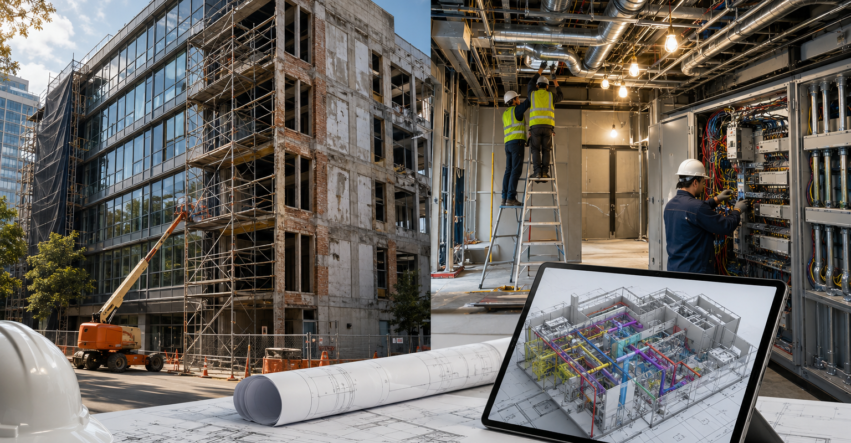
Across the United States and around the world, building owners are increasingly choosing to renovate and retrofit existing properties rather than construct entirely new facilities. Rising construction costs, sustainability initiatives, and the desire to extend asset life have made renovation projects an attractive investment strategy.
From office buildings and healthcare facilities to mixed-use developments and multi-family properties, retrofitting existing buildings can improve energy efficiency, increase property value, and modernize outdated infrastructure.
However, renovating an existing building is often far more complex than designing a new one.
Unlike new construction projects that start with a blank slate, retrofit projects require engineers and design teams to work within existing constraints, aging systems, and unknown conditions.
This is why engineering expertise plays a critical role in the success of renovation and retrofit projects.
A building retrofit involves upgrading existing systems, components, or infrastructure to improve performance, efficiency, functionality, or compliance with current regulations.
Retrofit projects can include:
The goal is to improve building performance while maximizing the value of the existing asset.
Several factors are driving the growth of renovation and retrofit projects.
Many commercial and residential buildings were constructed decades ago and no longer meet modern operational requirements.
Owners often need to upgrade systems to improve:
Organizations are under increasing pressure to reduce carbon emissions and improve environmental performance.
Retrofitting existing buildings is often more sustainable than demolition and new construction because it preserves existing materials and reduces construction waste.
Building a new facility can require substantial investment.
Many owners find that renovating an existing property provides a more cost-effective solution while still meeting operational needs.
Retrofit projects present challenges that are rarely encountered in new construction.
Existing buildings often contain:
These factors create significant complexity during both design and construction.
One of the biggest obstacles in renovation projects is the lack of reliable documentation.
Original drawings may be:
Over time, buildings often undergo modifications that are never properly documented.
As a result, project teams may discover unexpected conditions only after construction begins.
This can lead to:
Accurate site investigations and existing condition assessments are essential to minimizing these risks.
Existing buildings typically offer limited space for new infrastructure.
Mechanical rooms, ceiling cavities, and utility shafts may already be crowded with equipment and services.
Installing new systems often requires engineers to:
Space limitations are especially common in:
Creative engineering solutions are often necessary to achieve project objectives.
Mechanical, Electrical, and Plumbing systems frequently represent one of the most significant challenges in retrofit projects.
Many existing systems are:
Upgrading these systems requires careful planning to ensure compatibility with existing infrastructure.
HVAC retrofits often involve:
Engineers must balance performance improvements with practical installation considerations.
Older electrical systems may not have sufficient capacity to support:
Electrical upgrades often require significant coordination and phased implementation.
Plumbing retrofits can involve:
Addressing these challenges often requires detailed investigations and careful planning.
Unlike new construction projects, many renovation projects occur while buildings remain occupied.
Examples include:
Construction activities must often be phased carefully to minimize disruption.
Project teams may need to:
Maintaining operations while upgrading infrastructure is one of the most complex aspects of retrofit engineering.
Many older buildings were designed under codes that differ significantly from today’s requirements.
Renovation projects frequently trigger upgrades related to:
Understanding how modern regulations apply to existing buildings is critical to avoiding costly surprises during construction.
Energy efficiency has become a major driver for retrofit projects.
Owners increasingly seek to reduce:
However, improving energy performance in existing buildings often presents significant engineering challenges.
Potential upgrades may include:
The challenge lies in integrating these improvements within existing infrastructure.
Building Information Modeling (BIM) has become one of the most valuable tools in renovation and retrofit projects.
BIM helps project teams:
By creating accurate digital models of existing buildings, BIM enables better decision-making and minimizes costly surprises during construction.
Because existing buildings contain many unknowns, risk management is essential.
Successful retrofit projects often include:
Proactive planning significantly improves project outcomes and reduces unforeseen expenses.
Retrofitting existing buildings offers substantial environmental advantages.
Benefits include:
As sustainability requirements continue to evolve, building retrofits are becoming an increasingly important strategy for reducing the environmental impact of the built environment.
At InnoDez, we understand that every existing building presents unique challenges.
Our multidisciplinary expertise in:
allows us to develop practical, cost-effective solutions for even the most complex renovation projects.
By combining advanced technology with hands-on engineering experience, we help clients modernize facilities, improve building performance, and minimize operational disruption.
Renovation and retrofit projects present unique engineering challenges that require specialized expertise, detailed planning, and effective coordination.
From aging infrastructure and space limitations to code compliance and operational continuity, every retrofit project demands a thoughtful and integrated approach.
With the right engineering strategies, however, building renovations can deliver significant benefits, including improved efficiency, reduced operating costs, increased property value, and extended asset life.
As sustainability and modernization continue to shape the future of the built environment, renovation and retrofit projects will remain an essential part of creating smarter, more resilient, and more efficient buildings.


