
- Mon-Fri 9am-5pm
- [email protected]
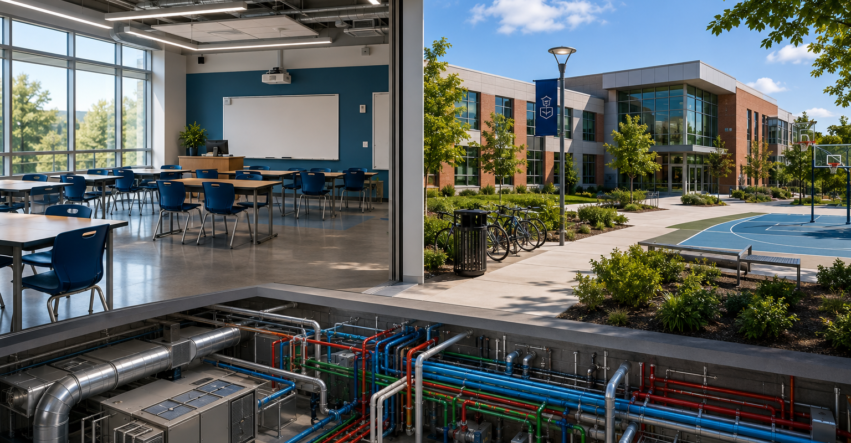
Educational facilities are more than classrooms—they are dynamic environments where students, educators, and staff spend a significant portion of their day. Schools, colleges, universities, and research campuses require reliable building systems that promote safety, comfort, energy efficiency, and flexibility for evolving educational needs.
MEP (Mechanical, Electrical, and Plumbing) engineering plays a critical role in creating these environments. From maintaining indoor air quality to ensuring dependable power and water systems, well-designed MEP solutions help educational facilities operate efficiently while supporting a productive learning experience.
At InnoDez, we provide integrated MEP engineering and BIM services for educational projects, helping owners, architects, and contractors deliver facilities that meet today’s requirements while preparing for future growth.
Educational buildings have unique operational demands compared to many commercial properties. They often accommodate hundreds or thousands of occupants, operate for extended hours, and include a variety of specialized spaces such as laboratories, libraries, cafeterias, auditoriums, sports facilities, and administrative offices.
Effective MEP engineering helps educational institutions:
A well-planned engineering design also minimizes maintenance issues and extends the lifespan of building systems.
Comfortable indoor conditions directly impact student concentration and staff productivity.
Mechanical engineering solutions typically include:
Proper HVAC design ensures consistent comfort throughout the campus while improving energy performance.
Healthy indoor environments have become a major priority for educational facilities.
Modern MEP designs focus on:
These systems help create healthier classrooms while supporting student well-being and academic performance.
Today’s educational facilities rely heavily on technology.
Electrical engineering includes:
Flexible electrical designs allow schools to adapt as educational technologies continue to evolve.
Educational buildings experience heavy daily water usage.
Plumbing engineering includes:
Efficient plumbing systems reduce water consumption while ensuring reliable operation.
Educational campuses often contain diverse facilities with unique engineering requirements.
Examples include:
Laboratories require:
Libraries require:
Large gathering spaces require:
Gymnasiums and athletic facilities require:
Many schools and universities are pursuing sustainability goals to reduce operating costs and environmental impact.
MEP engineering supports sustainable campuses through:
These solutions help institutions reduce utility costs while supporting long-term environmental objectives.
Educational projects involve multiple building systems that must work together seamlessly.
Building Information Modeling (BIM) enables project teams to:
BIM contributes to more efficient construction and better long-term building performance.
Educational institutions often expand over time.
Future-ready engineering designs consider:
Planning for future expansion reduces renovation costs and minimizes disruption to campus operations.
At InnoDez, we deliver integrated MEP engineering and BIM solutions that support safe, efficient, and adaptable educational environments. Our multidisciplinary approach ensures that mechanical, electrical, and plumbing systems work together to meet the unique needs of schools, universities, research facilities, and training centers.
By combining technical expertise, sustainable design principles, and advanced BIM coordination, we help clients create educational facilities that enhance occupant comfort, improve operational efficiency, and remain prepared for the evolving demands of modern education.


