- Mon-Fri 9am-5pm
- [email protected]
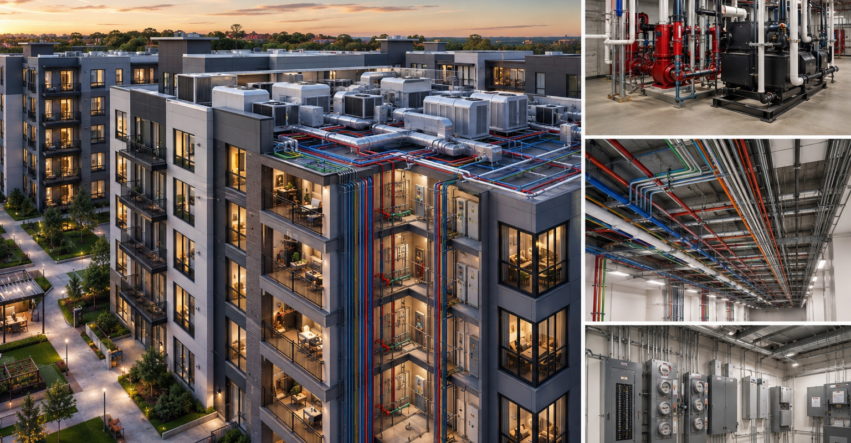
Multi-family housing developments continue to play a critical role in meeting growing housing demands across urban and suburban markets. From garden-style communities and mid-rise apartment complexes to build-to-rent developments and luxury residential towers, modern multi-family projects must provide comfort, energy efficiency, safety, and long-term operational value.
Behind every successful multi-family community is a carefully coordinated Mechanical, Electrical, and Plumbing (MEP) design strategy. These systems directly impact resident satisfaction, building performance, operating costs, and asset value throughout the life of the property.
As resident expectations evolve and sustainability requirements become more stringent, developers increasingly rely on experienced MEP engineers to deliver high-performing and future-ready residential communities.
At InnoDez, our multidisciplinary engineering teams provide integrated MEP design and BIM coordination services that help developers create efficient, sustainable, and market-leading multi-family housing projects.
Unlike single-family residential projects, multi-family developments involve significantly greater complexity due to the number of occupants, shared amenities, and centralized infrastructure.
Common design challenges include:
Addressing these challenges requires early collaboration between architects, developers, structural engineers, and MEP consultants.
Heating, ventilation, and air conditioning systems have a significant influence on resident comfort and building operating costs.
Several HVAC configurations may be suitable for multi-family developments, including:
System selection depends on factors such as:
MEP engineers evaluate these factors to determine the most effective solution for each project.
Indoor air quality has become a major priority for residents and property owners.
Modern multi-family developments increasingly incorporate:
These systems contribute to healthier living environments while supporting energy efficiency goals.
Reliable plumbing infrastructure is fundamental to the long-term success of multi-family housing.
Plumbing engineers carefully evaluate:
For larger developments, pressure zoning ensures consistent water delivery across all residential units.
Many multi-family projects utilize centralized domestic hot water systems to improve efficiency and simplify maintenance.
Common solutions include:
Proper system sizing is essential to ensure adequate supply during peak demand periods.
Sustainability initiatives often include:
These strategies help reduce utility costs while supporting environmental objectives.
Today’s residents expect robust and reliable electrical systems that support increasingly connected lifestyles.
Electrical engineers design systems to accommodate:
Advanced energy management technologies allow property owners and residents to monitor and optimize energy consumption.
Popular technologies include:
These solutions improve operational efficiency and promote energy awareness.
Electric vehicle adoption continues to increase rapidly.
As a result, multi-family developments increasingly require EV charging infrastructure.
MEP engineers assess:
Planning for EV charging during initial construction minimizes future retrofit costs.
Amenities have become a key differentiator in modern multi-family communities.
Common amenity spaces include:
Each amenity space presents unique MEP requirements related to HVAC, lighting, power distribution, plumbing, and life safety systems.
Proper engineering ensures these areas remain comfortable, efficient, and functional.
Protecting residents is one of the most important responsibilities in multi-family design.
Comprehensive life safety systems typically include:
Close coordination between MEP engineers, fire protection consultants, and code officials is essential to ensure regulatory compliance.
Noise control significantly impacts resident satisfaction in multi-family housing.
Mechanical systems, plumbing infrastructure, and equipment can generate unwanted sound transmission if not properly designed.
Common acoustic mitigation strategies include:
Prioritizing acoustic performance improves overall quality of life for residents.
Building Information Modeling (BIM) has become indispensable in multi-family construction.
BIM enables project teams to:
Early BIM coordination contributes to faster project delivery and reduced construction costs.
Developers increasingly seek sustainable building solutions that lower operating expenses and support environmental goals.
MEP sustainability strategies often include:
Sustainable design not only reduces environmental impact but also increases long-term property value.
Successful multi-family developments depend on reliable, efficient, and future-ready MEP systems. From concept design through construction, integrated engineering plays a vital role in delivering safe, comfortable, and high-performing residential communities.
At InnoDez, our experienced MEP engineers and BIM specialists help developers, architects, and contractors design multi-family housing projects that maximize efficiency, improve resident satisfaction, and support long-term operational success.
Contact InnoDez today to learn how our MEP engineering services can support your next multi-family housing development.


