
- Mon-Fri 9am-5pm
- [email protected]
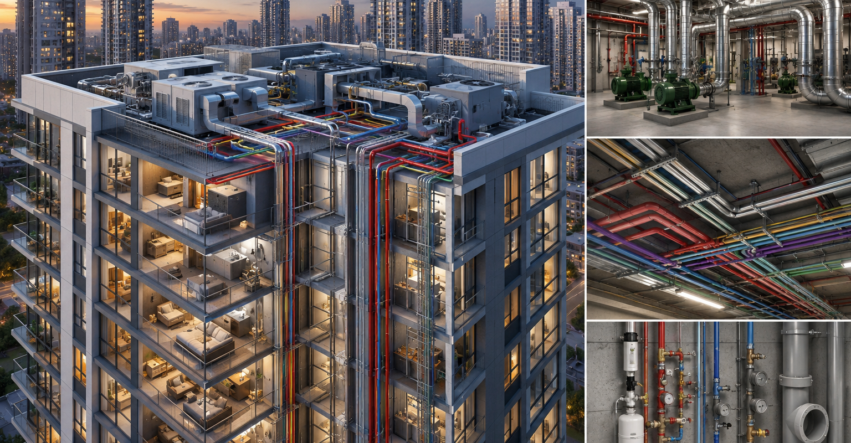
As urban populations continue to grow, developers are increasingly turning to high-density apartment buildings to maximize land use and address housing demand. These developments offer numerous benefits, including efficient land utilization, improved access to amenities, and enhanced sustainability opportunities.
However, designing building systems for high-density residential developments presents unique challenges. With hundreds or even thousands of residents living within a single building, mechanical, electrical, and plumbing (MEP) systems must be carefully engineered to ensure occupant comfort, operational efficiency, safety, and long-term building performance.
Poorly designed MEP systems can lead to inadequate heating and cooling, plumbing failures, excessive energy consumption, occupant complaints, and costly maintenance issues.
At InnoDez, our MEP engineering and BIM specialists work closely with architects, developers, and contractors to design apartment buildings that deliver reliable performance, energy efficiency, and exceptional resident experiences.
High-density apartment projects differ significantly from other residential developments.
Common challenges include:
Addressing these challenges requires an integrated MEP design approach from the earliest project stages.
One of the most significant constraints in apartment developments is the limited space available for MEP infrastructure.
Architects and engineers must coordinate systems carefully to maximize rentable and sellable floor area while maintaining serviceability.
Key strategies include:
High-rise apartment buildings require extensive vertical distribution networks for:
Carefully planned riser locations minimize shaft sizes and reduce coordination conflicts.
Selecting compact, high-efficiency equipment helps reduce plant room requirements while improving system performance.
Examples include:
Space-efficient solutions allow developers to maximize usable building area without compromising performance.
Providing comfortable indoor environments is one of the primary objectives of apartment MEP design.
Several HVAC approaches are commonly used in apartment developments, including:
The ideal system depends on factors such as:
Engineers evaluate these factors to determine the most appropriate solution for each project.
Residents spend a significant amount of time inside their homes, making indoor air quality essential.
Modern apartment buildings often incorporate:
Proper ventilation improves occupant health, comfort, and overall building performance.
Apartment buildings require robust plumbing systems capable of supporting large populations while maintaining reliability and efficiency.
Engineers must carefully design water supply systems to accommodate:
In taller buildings, pressure zones are essential to ensure adequate water pressure across all floors.
Efficient drainage design is equally important.
Plumbing engineers coordinate:
Early BIM coordination helps optimize pipe routing and reduce conflicts within congested ceiling spaces.
Apartment residents expect reliable electrical systems that support modern lifestyles.
Electrical engineers design systems that accommodate:
Individual metering allows residents to monitor energy consumption while simplifying utility billing.
Many new developments also incorporate:
These technologies help improve energy awareness and reduce operating costs.
As electric vehicle adoption continues to grow, apartment developments increasingly require EV charging capabilities.
MEP engineers evaluate:
Planning for EV infrastructure during initial design avoids costly retrofits in the future.
High-density residential buildings must comply with stringent fire and life safety regulations.
MEP and fire protection engineers coordinate:
Integrated life safety design protects occupants while ensuring code compliance.
Noise transmission is one of the most common causes of resident dissatisfaction in apartment buildings.
Mechanical systems can generate unwanted noise if not properly designed.
Common mitigation strategies include:
Prioritizing acoustic performance enhances resident comfort and improves long-term property value.
Building Information Modeling (BIM) plays a critical role in the successful delivery of apartment developments.
BIM enables project teams to:
Early BIM coordination significantly improves project outcomes and cost control.
Sustainability objectives are increasingly influencing apartment design.
Modern MEP strategies often include:
These solutions reduce operational costs while supporting environmental goals and regulatory compliance.
Designing MEP systems for high-density apartment buildings requires careful planning, technical expertise, and multidisciplinary coordination. Efficient, reliable, and future-ready building systems are essential for delivering successful residential developments.
At InnoDez, our experienced MEP engineers and BIM specialists provide integrated design solutions that help developers create apartment communities that prioritize comfort, efficiency, safety, and long-term performance.
Contact InnoDez today to discuss how our MEP engineering services can support your next apartment development project.


