
- Mon-Fri 9am-5pm
- [email protected]
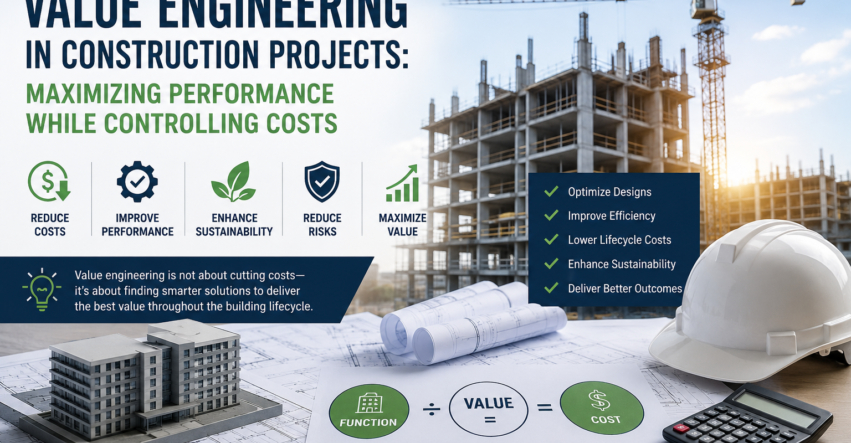
Construction projects today face increasing pressure from rising material costs, labor shortages, tighter schedules, sustainability requirements, and evolving client expectations.
Developers, property owners, architects, and contractors are constantly searching for ways to control costs without compromising quality, safety, or building performance.
This is where Value Engineering (VE) plays a critical role.
Despite common misconceptions, value engineering is not simply about reducing costs. Instead, it is a structured process that evaluates design solutions, materials, systems, and construction methods to maximize project value while maintaining or improving functionality.
When implemented effectively, value engineering helps project teams make informed decisions that reduce unnecessary expenditures, improve efficiency, and enhance long-term building performance.
Value engineering is a systematic approach used to analyze a project’s functions and identify opportunities to achieve the required performance at the lowest overall cost.
The primary goal is not to make a project cheaper but to improve the relationship between cost, quality, functionality, and performance.
The fundamental formula behind value engineering is:
Value = Function / Cost
This means value increases when:
Successful value engineering focuses on optimizing solutions rather than eliminating important project features.
Construction costs continue to rise due to factors such as:
Without careful evaluation, projects can quickly exceed budgets.
Value engineering helps project teams identify opportunities to:
This proactive approach creates benefits that extend well beyond project completion.
Many stakeholders mistakenly associate value engineering with cost-cutting measures that reduce quality.
In reality, effective value engineering seeks better solutions rather than cheaper alternatives.
Poorly executed cost-cutting may result in:
True value engineering focuses on preserving performance while eliminating unnecessary costs.
The objective is to spend smarter—not simply spend less.
The greatest opportunities for value engineering occur during the early design stages.
Making changes during conceptual design or schematic development is significantly easier and less expensive than making revisions during construction.
Early-stage value engineering allows teams to evaluate:
By identifying opportunities early, projects can avoid costly redesigns and change orders later.
Mechanical, Electrical, and Plumbing (MEP) systems typically represent a substantial portion of construction costs and long-term operating expenses.
Because of this, MEP engineering often presents some of the most impactful value engineering opportunities.
HVAC systems can account for a large percentage of a building’s energy consumption.
Value engineering strategies may include:
These improvements can reduce both installation and operating costs.
Electrical systems offer numerous opportunities for optimization.
Examples include:
Careful planning can reduce infrastructure costs while improving system performance.
Water conservation measures can generate long-term savings while supporting sustainability goals.
Potential strategies include:
These solutions often provide measurable returns throughout the building lifecycle.
Material selection plays a major role in project costs and long-term performance.
Value engineering examines alternatives based on:
The goal is to identify materials that provide the best overall value rather than simply choosing the lowest-cost option.
In many cases, investing slightly more upfront can significantly reduce future maintenance and replacement expenses.
Beyond cost savings, value engineering helps reduce project risks.
By reviewing designs from multiple perspectives, project teams can identify:
Addressing these issues before construction begins helps minimize delays and unexpected costs.
This risk reduction often delivers savings that exceed the direct cost reductions achieved through value engineering.
Sustainability and value engineering are increasingly connected.
Many sustainable solutions provide both environmental and financial benefits.
Examples include:
Although some sustainable systems require higher initial investments, they often generate significant operational savings over time.
Value engineering helps determine which sustainability initiatives provide the strongest return on investment.
One of the most important aspects of value engineering is evaluating lifecycle costs rather than focusing solely on upfront construction expenses.
A system with a lower installation cost may ultimately become more expensive due to:
Lifecycle cost analysis considers:
This broader perspective supports smarter investment decisions.
Building Information Modeling (BIM) has significantly improved the value engineering process.
BIM allows project teams to:
By providing accurate project data early in the design process, BIM helps teams make informed decisions that improve value while reducing risk.
At InnoDez, value engineering is integrated into our design and coordination process from the earliest project stages.
Our multidisciplinary expertise in:
allows us to evaluate projects from multiple perspectives and identify opportunities to improve efficiency, performance, and cost-effectiveness.
By combining technical expertise with practical construction knowledge, we help clients maximize project value while maintaining the highest standards of quality and performance.
Value engineering is one of the most effective strategies for improving construction project outcomes.
When implemented correctly, it helps reduce unnecessary costs, improve building performance, minimize project risks, and enhance long-term operational efficiency.
Rather than focusing solely on budget reductions, value engineering encourages smarter design decisions that create lasting value throughout the building lifecycle.
For developers, architects, contractors, and property owners, value engineering is no longer an optional exercise—it is a critical component of successful project delivery in today’s increasingly complex construction environment.


